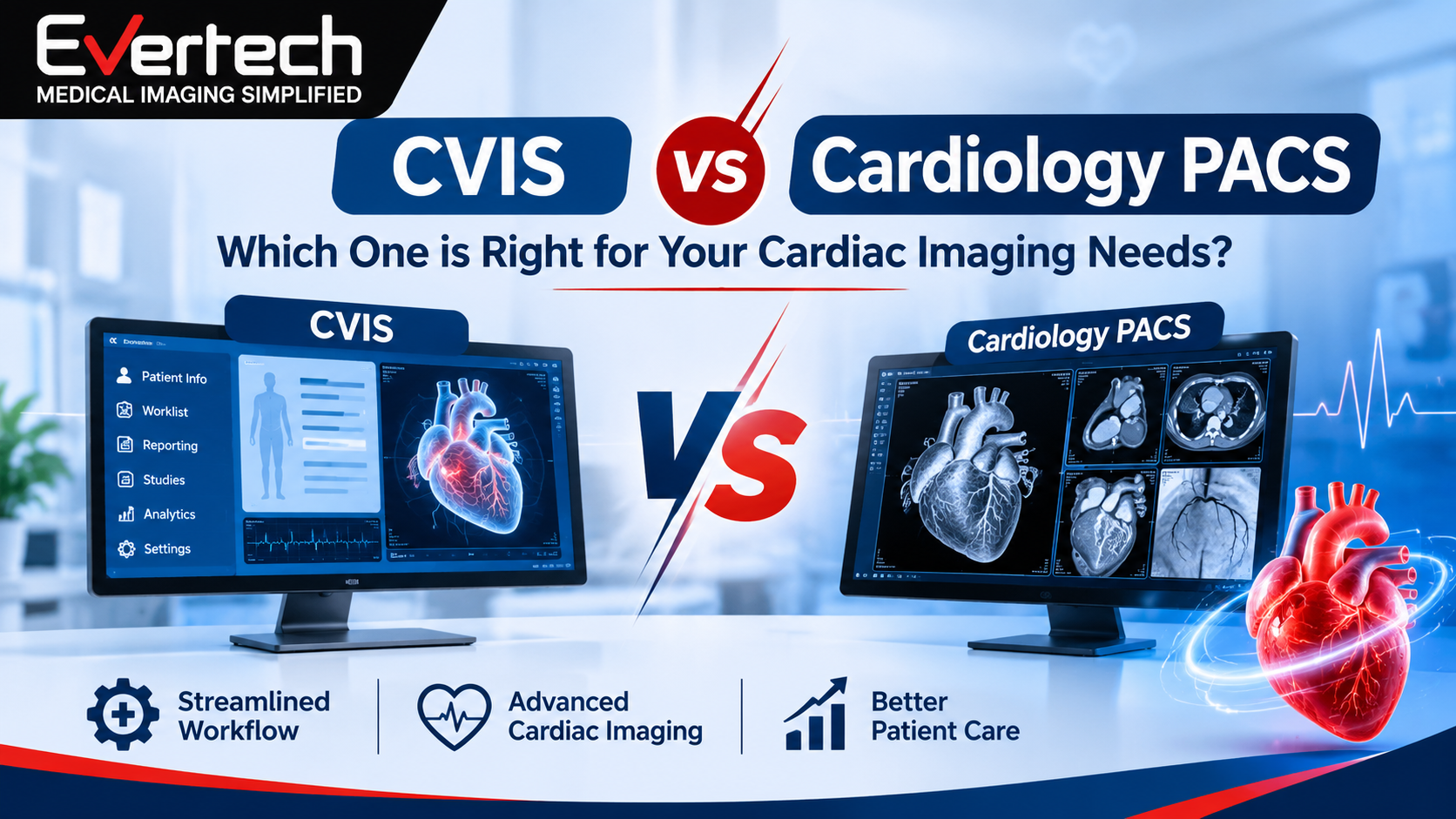
The healthcare industry is increasingly adopting advanced digital technologies to improve patient care, streamline clinical operations, and manage medical data more efficiently. In cardiology, two important technologies supporting this transformation are the Cardiovascular Information System (CVIS) and Cardiology Picture Archiving and Communication System (PACS). CVIS focuses on managing cardiovascular patient information, clinical documentation, reporting, and departmental workflows, whereas Cardiology PACS primarily handles the storage, retrieval, viewing, and sharing of cardiac medical images.
Understanding CVIS vs Cardiology PACS is essential for hospitals, diagnostic centres, and cardiology departments looking to choose the right technology for their requirements. Both solutions can also work together to create a more connected imaging environment, improve information accessibility, and support efficient clinical workflows. With its healthcare software expertise, Everrtech Software Limited aims to support modern healthcare facilities through advanced medical imaging and information management solutions. Contact us to learn more on +91 35255500 and e-mail us on info@everrtech.com.
What Is a Cardiovascular Information System (CVIS)?
A Cardiovascular Information System (CVIS) is a software program that stores all the information related to cardiac and cardiovascular care and assists various hospitals, diagnostic centers and cardiac clinics in storing, organizing and streamlining clinical data. It enables hospitals and other cardiology clinics to maintain patients' records, document clinical results, keep track of cardiology actions, and facilitate the day-to-day functions of various cardiology departments by providing a single source of digital information. Normally, the CVIS supports a number of important functions, such as:
-
Patient Data Management: This hospital management system maintains and categorizes patient data, including demographic details, history, diagnoses and cardiovascular records.
-
Clinicians' support: Facilitates cardiologists' documentation of examination, drug administration, and procedure information.
-
Reporting Administration: Facilitates the generation, storage, and access of cardiovascular exam and procedure reports.
-
System Integration: Able to integrate with EHR, HIS, and Imaging systems.
-
Operational Monitoring: Allows administrators to keep an eye on department activity, procedure volume, and operations.
What Is Cardiology PACS?
Cardiology Picture Archiving and Communication System (PACS) Cardiology PACS is a medical imaging software used to acquire, store, retrieve, view and distribute cardiac images and related diagnostic studies. This system allows hospitals, cardiac centres and diagnostic centres to be equipped with a storage and review system for high volumes of cardiac images. The software provides radiologists and cardiologists with medical images so they can review the diagnostic reports. It may store medical images in electronic format and offers its capability to transfer the imaging data with other compatible healthcare information systems and devices. Key Functions of Cardiology PACS are:
-
Stores cardiovascular images and diagnostic studies in a secure digital storage location and allows easy access to and long-term management of images.
-
Handles storing, retrieving, and exchanging medical images based on the Digital Imaging and Communications in Medicine (DICOM) standard.
-
Enables a clinician to view, zoom, compare and analyze various cardiac imaging studies through diagnostic viewer applications.
-
Allows designated providers to access and share imaging studies across connected departments and facilities.
-
Assists in keeping imaging study records organized and mitigates data protection, backup and retention needs.
CVIS vs Cardiology PACS: What Are the Major Differences?
While cardiovascular information systems (CVIS) and cardiology picture archiving and communications systems (PACS) serve different roles in today's cardiac hospital, they each have unique functionalities and applications. Knowledge of these discrepancies assists hospitals, diagnostic centres and cardiology departments in choosing the appropriate software according to their usage and needs of imaging.
1. Primary Purpose and Functionality
The key differences between CVIS and Cardiology PACS concerns the end-goal of the information system. The CVIS is intended to facilitate the overall information needs of a cardiovascular unit, including patient records, clinical information, reports, and the scheduling of procedures.
2. Image Storage and Management
While CVIS may offer image access from cardiovascular imaging systems, it is not a true image archiving solution. Cardiology PACS Cardiology PACS is a system for the central storage and retrieval of medical images. It is used for DICOM imaging workflow and lets users access the cardiac imaging images at any time needed.
3. Patient Data and Clinical Documentation
The CVIS offers more comprehensive patient information management features. It is capable of structuring patient demographics, a comprehensive history, clinical findings, exam, and related procedure-related documentation. The cardiology PACS mainly deals with imaging data, including image studies and their data, with any relating to imaging and with connections to diagnostic data.
4. Reporting and Workflow Management
CVIS enables the cardiovascular clinical workflows to improve documentation, scheduling, reporting, and processes within your department. The Cardiology PACS addresses imaging workflows such as image acquisition, archiving, retrieval, display, and distribution.
5. Integration with Hospital Information Systems
Supported EHR, HIS, LIS, and PACS integration which allow for different applications on each platform. Can be integrated with documentation platforms and other clinical applications. Provides interfaces to other healthcare systems such as imaging devices, CVIS, RIS, EHR and others to enable the exchange of images and improve access to images throughout the healthcare enterprise.
6. Accessibility and Data Sharing
CVIS offers cardiovascular specific patient information for use by authorized healthcare users, along with a clinical record, and procedure documentation. The cardiology PACS provides the ability for cardithoracic imaging examinations to be viewed and shared across connected facilities, networks or departments.
What Are the Key Features of a CVIS System?
A Cardiovascular Information System (CVIS) provides multiple benefits to help streamline cardiovascular information, enhance clinical processes and minimize inefficiencies when caring for patients.Below are some main features of a CVIS system:
1. Comprehensive Patient Data Management
CVIS stores all cardiovascular patients' records- demographic data, medical data, past history, diagnosis, examination records, and treatment data. By implementing a CVIS, cardiologists and other authorized personnel can avoid switching from one system to another.
2. Clinical Documentation and Reporting
This system allows doctors and clinicians to organize, access, and generate cardiovascular clinical reports. It may also be used to record procedures and diagnostic tests to eliminate paper-based reports and generate standardized patient information.
3. Cardiovascular Workflow Automation
Once we get CVIS up and running, we'll be able to automate much of the routine duties in our cardiology department like scheduling and registering patients, following up on procedures, and clinical documentation.
4. Procedure Scheduling and Tracking
A CVIS can assist in scheduling cardiovascular procedures, tracking the status of procedures and entering related records. This will enhance the interaction of cardiologists with technicians, nurses and other department personnel.
5. Linkage with EHR & HIS Platforms
Data Integration CVIS can share pertinent data with your existing Electronic Health Records (EHRs), Hospital Information Systems (HIS), and other applications. This streamlines access to data, eliminates redundant data entry, and increases continuity of care.
6. Cardiovascular Imaging Integration
A CVIS can communicate with Cardiology PACS and select other imaging modalities to provide cardiovascular imaging exams and clinical data, facilitating the review of cases alongside other diagnostic images.
What Are the Benefits of Integrating CVIS and Cardiology PACS?
With a Cardiovascular Information System (CVIS) linked to a Cardiology Picture Archiving and Communication System (Cardiology PACS), they are able to incorporate clinical information, patient reports, diagnostic images, and cardiac test results into one solution. Below are the key advantages of adopting CVIS and Cardiology PACS:
1. Centralised Patient Data Management
With integration, Doctors can readily view patient demographics, their history, diagnostic reports, ECGs, echocardiography and other cardiac images from a central database. This avoids information duplication, and reduces the time spent on manual record keeping.
2. Improved Clinical Workflow Efficiency
Integrated CVIS and Cardiology PACS reduce workload by automating routine tasks like registration, scheduling, storage of images, reporting and reporting results, thereby reducing the need for repetitive work.
3. Faster Diagnosis and Clinical Decision-Making
With full-view access to cardiovascular images, test results and clinical data, cardiologists can see the entire patient record in a single application, rather than toggling between separate systems.
4. Better Collaboration Among Healthcare Professionals
Interoperability enables your cardiologists, radiologists, technicians and other licensed health professionals to access and exchange information. This can lead to better collaboration across specialties, making it easier to consult with experts.
5. Reduced Operational Costs
The use of two various systems – the CVIS and the Cardiology PACS – can lead to higher software maintenance, infrastructure, training, and administrative costs. A combined solution avoids duplicate processing, reduces manual effort and optimises resourcing.
How to Choose Between CVIS and Cardiology PACS for Your Healthcare Facility?
You need to determine whether your hospital or practice's clinical needs, diagnostic work flow, infrastructure and future aspirations are best suited for a Cardiology PACS or CVIS. Here are some factors you should keep in mind before choosing the right solution for your healthcare property:
1. Identify Your Healthcare Facility's Requirements
First, consider your facility's daily cardiovascular workflows and diagnostic requirements. When your main priority is focusing on cardiology-related patient charts, exam scheduling, clinical documentation, and departmental workflows, then CVIS might be a better fit.
2. Evaluate Your Cardiovascular Imaging Requirements
Cardiology: echocardiography, cardiac CT, angiography, and other imaging volumes are higher, reliable image management can be critical. Cardiology PACS is helpful for storage, viewing and access to the studies, whereas CVIS may be necessary to leverage more general clinical data management capabilities.
3. Ask About Workflow Automation Needs
Decide the level of automation you need. CVIS can reduce your workload when registering patients, scheduling procedures, reporting, and running the cardiac workflow. Cardiology PACS is more geared toward automating the archiving, retrieval, distribution, and viewing of images.
4. Check Integration and Interoperability
The solution you choose must be compatible with the existing hospital information system, EHR, LIS and diagnostic equipment. Search for such standards as DICOM and HL7 that allow you to exchange information securely and consistently across healthcare applications.
5. Assess Budget and Infrastructure Requirements
Examine the total cost of ownership for each solution, including the purchase price, cost of implementation, ongoing maintenance costs, storage needs, and staff training requirements.
Conclusion
The decision on whether to choose a CVIS vs Cardiology PACS depends on your healthcare facility's clinical needs, imaging needs, workflow requirements, and future growth plans. Though CVIS can be used for all the cardiovascular clinical information and workflow management, and Cardiology PACS for storing, viewing, and retrieving, and sharing cardiology diagnostic images, both systems enhance clinical ability and aid in diagnosis. However, for those interested in cardiology workflow management and imaging management – an integrated CVIS-PACS solution is the answer.